
Story from Children's Ground, Aus.
Children engaged in a play-based, experiential learning adventure on Country, exploring, discovering, and learning through doing and observing alongside educators and community members. During the journey, they searched for ankerte (goanna), experiencing the excitement of spotting and catching one, which sparked curiosity, conversation, and shared knowledge about local animals.
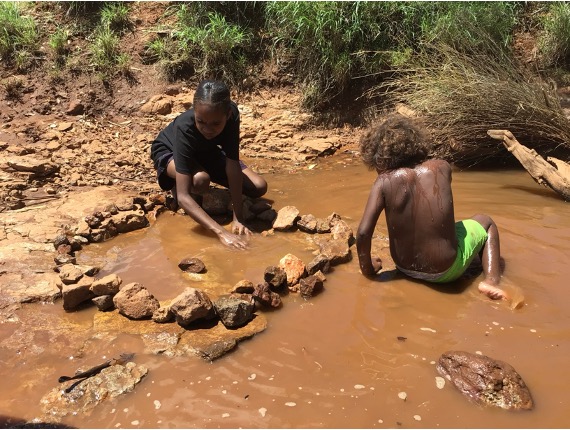
At the water place, children immersed themselves in sensory and imaginative play. They splashed in the kwatye (water), searched for tadpoles, balanced rocks, and used their imaginations to pretend to be animals moving through the water. These experiences supported physical coordination, confidence, and creativity, while also providing opportunities for emotional regulation through calm, rhythmic, and repetitive play in a natural environment.
Educators and community members enriched the experience by sharing cultural knowledge and practices. Natural ochre was crushed into powder for the children to use as paint, exploring white, red, and yellow colours. Children observed and participated in this process, learning through watching and doing, while also hearing about the significance of materials, including the use of white ochre in ceremony. Bush medicine was also collected for use in future learning, strengthening connections to Country and traditional practices.
Music and storytelling further supported children’s engagement and sense of belonging. Children sat with family members, using wooden mortar and pestles as instruments, singing in language to the rhythm of the “Alkere (Sky)” song. This created a shared, joyful experience that supported language development, listening skills, and cultural identity.
This experience highlights the depth of play-based experiential learning, where children learn holistically through active participation, observation, and meaningful interactions. It supported the development of social-emotional skills, strengthened relationships, and provided rich opportunities for language learning in context. Being on Country allowed children to connect deeply with their environment, culture, and community, making learning relevant, engaging, and grounded in their lived experiences.